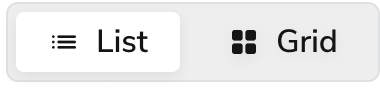
Anatomy

The Segmented Control has three elements that work together to switch the presentation view of current or filtered content.
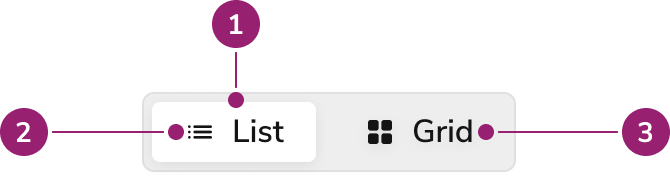
segmented control
anatomy
  1. Selected segment
  2. Icon
  3. Label

Options

The Segmented Control supports multiple sizes, fill options, and icon configurations for different use cases.

Sizes

Fill

By default, Segmented Control will hug its content. But it can also fill available width.

Icons

Place icons before the segment’s text label, or use them to replace the text label as an icon-only segment. Use icon-only segments with Tooltip to provide an accessible label.

Behavior

The Segmented Control responds to user interaction with distinct visual states and selection behaviors.

Visual States

Default

Default segments do not have a focus-visible state because only the selected segment receives focus.

Selected

Selected segments do not have hover or active states because users cannot interact with them when selected.
  • Only one segment remains selected at all times
  • At least one segment remains selected at all times

Focused

Only the selected segment receives focus.

Usage Guidelines

Use the Segmented Control when switching the presentation view of current or filtered content.

When to Use

Use Segmented Control for 2-5 selections. Currently it lacks native overflow handling, so test for mobile responsiveness when using this component.

Alternatives

Segmented Control vs Radio

Radios are form controls that users must explicitly submit. Use Segmented Controls for selections that affect the UI immediately.

Segmented Control vs Tab

Segmented Control allows users to change the presentation format of displayed content or to filter it. Tabs change the view to show new content.

How to Use

Switching presentation mode

Use Segmented Control to toggle between different presentation modes such as grid vs list.

Filtering content

Use Segmented Control to filter data into segments, providing users with a smaller set of data to engage. Including a number helps indicate how many items are in each filtered segment.

Sorting content

Use Segmented Control to allow users to sort a list or display by different criteria (e.g., “Newest,” “Oldest,” “Most Popular,” “Alphabetical”). The core content remains the same, but its order changes.

Switching Data Granularity/Time Ranges

Use Segmented Control to toggle between different temporal views of the same data or different interpretations of the same data. Another example includes switching between a percentage (%) or dollar amount ($).

Toggling Sub-Categories

Use Segmented Control when a section has closely related, but distinct, sub-sections.

Selecting an Option in a Form

Use Segmented Control for a small number of mutually exclusive choices within a form. It provides a visually appealing and efficient alternative to traditional radio buttons, especially when space is a concern.

Content

Use labels and icons to clearly communicate each segment option.

Keyboard Interaction

Users can navigate the Segmented Control using standard keyboard controls.
KeyInteraction
Arrow RightWhile focused, selects the Segment on the right
Arrow LeftWhile focused, selects the Segment on the left

Accessibility

  • Icon-only segments require an accessible name via aria-label or aria-describedby.
For more guidance on form field labels and context, see input field context association best practices.
Last modified on January 23, 2026